It's been a long time between posts, but the second half of last year was spent almost exclusively on establishing the veggie garden.
We built long narrow beds from corrugated iron (recycled, of course!). Because of the slope they are shallower on one side than the other, but still deep enough for anything we're likely to grow.
They are filled with a "lasagna" mix of layers of straw, manure, compost, lovely Mount Glorious red soil, and liberal sprinklings of Dynamic Lifter. The whole area is netted to keep out the turkeys and larger birds like bower birds, but the netting will let through the little birds that eat insects.
So far this year we have harvested beans, broccoli, Asian greens, capsicum, garlic, lettuce, rocket, potatoes and sweet potatoes, snow peas, silverbeet, three types of tomatoes and zucchini, as well as ten or so different herbs. I've bottled loads of tomatoes for use during winter, particularly the small Black Russians, which produced enormous quantities of perfectly formed, fabulously tasty fruit.
Behind the veggies are three bays for making compost. Further down the hill are two cut-down water tanks, which hold bananas and pumpkins. Strawberries, carrots, asparagus, ginger and eggplant are now coming on. The sweet potato will probably be moved to the slope outside, where it can run wild.
It's a constant learning experience discovering what works and what doesn't, but I never tire of the excitement of whipping up a meal that's essentially from our garden. And the bonus is I don't have to go shopping nearly as often. More time on the mountain!
Showing posts with label self sufficiency. Show all posts
February 22, 2014
February 28, 2012
We need to talk about Kevin!
I've just finished reading Kevin McCloud's Principles of Home - Making a Place to Live.
You may or may not be a fan of Kevin and his Grand Designs (I admit to being a real Kevin tragic!), but he has a sensible and refreshingly positive approach to sustainable living. He believes we need to embrace a slower, more enjoyable and gentler way of living that is less taxing on the resources of the planet, but that we don't have to compromise our comfort or lifestyle to do it.
He also believes that despite our current depletion of the planet's resources, we will be saved by our own resourcefulness and imagination, by returning to good design and craftsmanship, and by embracing a philosophy of sharing rather than wanting everything for ourselves.
The book offers practical suggestions on both building and retrofitting your home to make it energy efficient, how to shop sensibly and ethically, and what items are worth investing in (and what aren't), as well as looking at what a home offers in terms of social and personal values.
Kevin McCloud practices what he preaches. His building company, Hab (It stands for Happiness Architecture Beauty.) builds low-cost, affordable and sustainable homes, designed in the belief that they should enrich the environment, create a sense of community and make people happy.
You may or may not be a fan of Kevin and his Grand Designs (I admit to being a real Kevin tragic!), but he has a sensible and refreshingly positive approach to sustainable living. He believes we need to embrace a slower, more enjoyable and gentler way of living that is less taxing on the resources of the planet, but that we don't have to compromise our comfort or lifestyle to do it.
He also believes that despite our current depletion of the planet's resources, we will be saved by our own resourcefulness and imagination, by returning to good design and craftsmanship, and by embracing a philosophy of sharing rather than wanting everything for ourselves.
The book offers practical suggestions on both building and retrofitting your home to make it energy efficient, how to shop sensibly and ethically, and what items are worth investing in (and what aren't), as well as looking at what a home offers in terms of social and personal values.
Kevin McCloud practices what he preaches. His building company, Hab (It stands for Happiness Architecture Beauty.) builds low-cost, affordable and sustainable homes, designed in the belief that they should enrich the environment, create a sense of community and make people happy.
Labels:
Eco building,
Eco living,
self sufficiency
1 comments
December 1, 2011
The magic of seeds!
In the past I’ve always bought herb and vege seedlings, at reasonable expense and with mixed success. Now I’ve started growing my herbs and vegetables from seed, and I’ve been excited by both the ease and the success.
Seeds fascinate me – how can something so tiny – like a speck from packet of hundreds and thousands – grow with just a little water and sunlight into a plant that provides food?
I started planting seeds in pots on the sunny windowsill in the dining room. As they’re in prime view, they’ve got a fair chance of being watered regularly! Within days they had shoots, and in a couple of weeks I was planting them out in the new vege patch.
Last night we ate mixed salad leaves and snow peas from our garden, with avocado from the neighbour’s, and tonight there’ll be home grown bok choy and snow peas in the stir fry.
In a few weeks we’re expecting pumpkin, zucchini and capsicum, as well as an ongoing crop of tomatoes, together with fresh basil for the pasta, and coriander for the Thai dishes. It’s not self-sufficiency, but it’s a start!
Labels:
Mountain life,
self sufficiency
0
comments
March 17, 2011
Growing veges - the minimalist approach
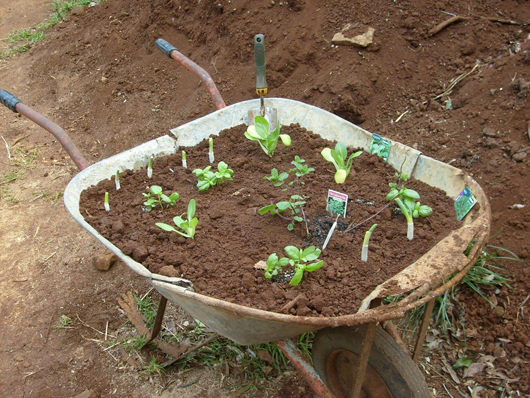
Building a house doesn't leave much time for gardening, which seems to be relegated to the lowest priority. So late last year, desperate to have some sort of vegetable garden, I hit on the idea of a mobile vege patch. It would catch the sun as it moved through the seasons, and could be shifted out of the way when other work was being done.
Unlike the rest of the garden, it survived very well over the summer. The wheelbarrow provided good drainage when torrential rains left everything else waterlogged, and being above ground level, it was out of the way of many of the bugs.
Coupled with various pots of herbs, it provides a bare minimum of home grown produce until I can get a proper vegetable patch established.
Unlike the rest of the garden, it survived very well over the summer. The wheelbarrow provided good drainage when torrential rains left everything else waterlogged, and being above ground level, it was out of the way of many of the bugs.
Coupled with various pots of herbs, it provides a bare minimum of home grown produce until I can get a proper vegetable patch established.
Labels:
plants and trees,
self sufficiency
0
comments
Subscribe to:
Posts (Atom)